

A few minutes earlier, the excitement was strong; Just after the orgasm, the desire almost completely disappears and a desire to sleep or stay quiet takes its place. On the Internet, this state is sometimes called «Sage Time» or «Sage Moment».
Some people describe it as a great calm, others as a feeling of emptiness, a sudden drop in interest in erotic content or a short period of melancholy. These reactions may seem surprising, but a large part corresponds to normal changes that follow orgasm.
What is «Sage Time»?
The expression comes from the Japanese internet culture and above all describes the mental state that can follow ejaculation or orgasm: clearly reduced excitement, less present sexual thoughts and the impression of suddenly finding a great «lucidity».
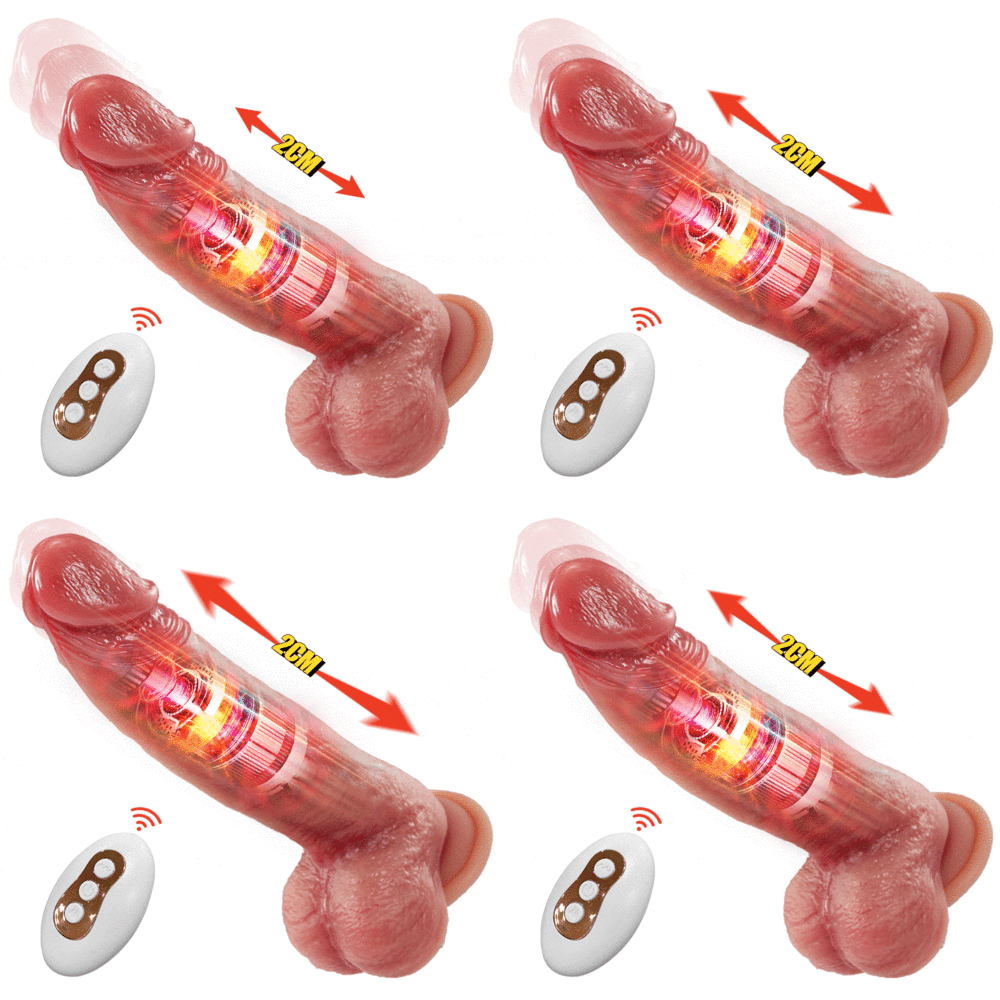 Thick, fast and powerful vibrating dildo to easily reach orgasm with hot function42,99€View product
This term is not a medical diagnosis. It actually mixes several phenomena: the phase of resolution of the sexual response, the male refractory period, fatigue and, in some people, negative emotions after sex.

A man can just feel relaxed and satisfied. Another can be very sleepy. A third may momentarily feel sadness or irritability. Variability is important.
What is the refractory period?
After ejaculation, many men go through a period during which it is difficult, if not impossible, to immediately find the same level of excitement or a new erection. It's the refractory period.
During this phase, the penis may also be more sensitive to touch, to the point that continuing the stimulation becomes unpleasant. The body gradually changes from a state of intense excitement to a calmer state.

This period does not mean that the sperm must be «reconstituted» before any new erection. The answer is mainly related to the nervous and neurochemical mechanisms that change after orgasm.
Which chemical messengers are involved in the change?
During excitement and orgasm, several brain and body systems are active. Dopamine participates in particular in motivation and reward circuits. After orgasm, other messengers, including prolactin and oxytocin, were studied for their role in sexual satiety and resolution phase.
Serotonin and the autonomic nervous system also participate in the sexual response, but it would be too simple to say that a single hormone «cuts off» desire.

Orgasm can also be followed by a decrease in heart rate and muscle tension, which promotes a feeling of relaxation and sometimes sleep.
How long does the refractory period last?
There is no standard duration. In some men, a few minutes are enough before a new excitement is possible. In others, it takes several hours or more.

Age can influence this duration, but there is no reliable table of the type «20 years = 15 minutes, 45 years = 48 hours». Sleep, fatigue, medication, alcohol, health, level of excitement and individual differences also matter.
Even in the same person, the period can be short one day and much longer another time.
Women can sometimes chain several orgasms more easily, but they too may have hypersensitivity or need a break after an orgasm. Individual responses are very varied.
Can we shorten this moment?

There is no guaranteed method to reduce the refractory period to a specific duration. Promises of the «30-minute jogging reduce the period by 20 %» or «oysters allow you to leave faster» should not be presented as rules.
On the other hand, habits that support general health can also support sexual function: sufficient sleep, regular physical activity, balanced diet, limitation of excess alcohol and management of medical problems.
If you are exhausted, trying to force a second erection is generally not more productive than letting the body recover.
Should you change your way of making love?

Sexuality should not stop because a new penetration is not immediately possible. After a partner orgasm, the couple can continue with caresses, kisses, manual stimulation or a sex toy if the other person wants to.
This way of thinking also takes away part of the pressure linked to the idea that a man should «return» immediately.
If you know that your refractory period is long, you can organize the report so that the partner's needs are taken into account before or after your own orgasm.
And the sex toys?

A masturbator, vibrating ring or other accessories may vary the stimulation, but no sex toys remove the refractory period from biologically.
Just after ejaculation, a strong glans stimulation can be uncomfortable. It is often better to reduce the intensity or pause rather than continue with a powerful device.
In a couple, a vibrator can on the other hand allow the pleasure of the partner to continue while the man recovers.
Why do some people feel sad after sex?

A drop in mood after a sex or masturbation can happen. We sometimes speak of post-coital dysphoria when a person feels sad, irritability, anxiety or desire to cry after a consented sexual activity.
An occasional episode is not necessarily worrying. If these emotions are strong, repeated or related to guilt, trauma or distress in the relationship, it may be useful to talk to a professional about it.
Do not reduce all post-orgasm emotions to a simple «dopamine drop»: personal history and psychological context also matter.

How to better live the «Sage Time»?
Accept the recovery phase
Do not consider the immediate decline of desire as a problem. If your body asks for a break, give it to it.
Maintain closeness to the partner

The absence of sexual desire for a few minutes does not prevent hugs, caresses, conversation or simply the fact of staying together. This period can be very intimate without having to become immediately sexual again.
Avoid judging
If you masturbated and then feel a little discomfort or guilt, ask yourself if it comes from your values, education or behavior that you really want to change. Masturbation itself is not medical malpractice.
Check if a change is important

A longer refractory period with age may be normal. On the other hand, if you notice a lasting drop in libido, erectile disorder, unusual fatigue or other symptoms at the same time, medical advice may be relevant.
to remember
The «Sage Time» above all describes the transition between strong excitement and the recovery phase after orgasm. In humans, the refractory period explains why a new erection or a second orgasm is not always immediately possible.
Its duration varies a lot and it is not necessary to fight it. Respecting the rhythm of the body, maintaining communication with the partner and not transforming recovery into a performance test generally allows you to better live this moment.
 French
  English (United States)
  German
  Spanish
  Portuguese
  Italian
  English (UK)